
12-Month Recovery Program
Telehealth physiotherapy support from preparing for your operation through to the 12-month mark, for ACL reconstruction, meniscal repair and meniscectomy.
Recovery from ACL or meniscus surgery can extend over the year following your operation and is often longer than you may expect. This program gives you structured telehealth physiotherapy oversight across your whole recovery. It runs alongside the hands-on care you get from your local physiotherapist, never in place of it.
It starts before your operation if there's time, helps you get set up with a hands-on physio near you, and gives you a direct line to your physiotherapist in the Well2Wise app for the quick questions that can't wait for your next scheduled session. Telehealth simply means your consultation happens by video call, so you can have it from home, from work, or from wherever you happen to be that month.
Talk to us about the 12-Month Recovery Program
Tell us your surgery type and roughly when it's happening, and we'll explain how the program would work for you. No obligation.
Why 12 months?
Because knee recovery is measured in seasons, not weeks, and the timeline depends on which operation you had.
After an ACL reconstruction, where the torn ligament is replaced with a graft, rehabilitation commonly runs for around nine to twelve months before a return to pivoting sport, and that return is normally guided by strength and movement testing rather than by a date on the calendar.
After a meniscal repair, where the torn cartilage is stitched back together and needs time to heal, protocols are usually measured in months rather than weeks, and often start with restrictions on how much weight you put through the leg and how far you bend the knee.
After a meniscectomy, where the damaged part of the cartilage is trimmed away instead of repaired, recovery is much shorter, often a matter of weeks to a few months. If that's your operation, the ACL timelines above don't apply to you, and the program is used differently: fewer big milestones, more focus on rebuilding strength early so a lasting weakness doesn't set in. Your physiotherapist will talk this through with you at your first consult.
What tends to go wrong over a long recovery
The main risk over a long recovery is drift. Rehabilitation is intense in the first weeks, then life gets busy, appointments get further apart, and the program quietly loses momentum. Milestones get skipped, strength work tapers off, and decisions about returning to sport end up being made on how the knee feels rather than on how it performs against clear criteria.
This program is designed to reduce that drift by putting scheduled review points across the full 12 months, so someone is checking your progress against the stage you're actually at. It is evidence-informed and general in nature; your own timeline is set by your surgeon and your treating physiotherapists based on your knee, your operation and your goals.
Before your operation
If there's time before your surgery date, the program starts there rather than waiting until you wake up from the operation.
Physiotherapy done before an operation is often called prehab. Your first consultation, the pre-op consult, is held before surgery wherever there's time, and it's used to work through the things that are far easier to sort out now than in the fortnight afterwards.
What the pre-op consult covers
- Guided movement screen and baseline knee scores. Your physiotherapist takes you through a set of movements on the video call and watches how the knee behaves, then records your baseline knee scores: short standard questionnaires covering pain, function and how much you trust the knee. Together they give every later review something real to compare against. Anything needing hands-on measurement is done by your local physio and fed back in
- A prehab plan to settle the knee before surgery. Pre-op exercises from our exercise library in the Well2Wise app, with video and written instructions, aimed at calming swelling, getting the knee straightening properly and holding the strength you've got. Surgeons pay attention to all three before operating
- Your rehab roadmap and milestones explained. What the stages after the operation look like and roughly when each review falls, so the plan isn't a surprise once you're sore and on crutches
- The right level of support confirmed. An honest conversation about whether the full 12-month program suits your situation, or whether one-off consults alongside your local physio would serve you better
- Learning the early exercises in advance. The post-operative movements you'll be asked to do in the first days afterwards are much easier to learn from the library before you're sore
- Getting everything else ready. The practical side of the first few weeks after your operation, worked out before surgery rather than after
Still deciding? You can get a second opinion first
Not everyone who enquires has made a final decision, and there's nothing unusual about wanting another view before committing to an operation. If you'd like a second opinion on whether to operate, on which operation, or on the timing, we can arrange a consultation with an orthopaedic surgeon in the Well2Wise network, bookable through the app.
Those consultations are with independent orthopaedic surgeons. Well2Wise arranges the booking and handles the payment side; the clinical opinion is entirely the surgeon's. A surgeon consultation is booked and paid for separately. It isn't part of the program fee. How surgery works through Well2Wise →
Our physiotherapists don't decide whether you should have surgery and won't push you either way. What they can do is help you understand what each path involves and what to ask. Our injury guides cover the same ground in more detail: ACL injury, meniscus injury, and surgery vs brace-and-wait.
None of this replaces your surgeon's pre-operative instructions. If the two ever differ, your surgeon's instructions come first. And if your operation has already happened, that's completely fine: plenty of people join afterwards, and the consult becomes a baseline one, used to record where you're up to instead.
What's included
Six scheduled telehealth consultations with one of our physiotherapists, spread across the 12 months after your surgery.
- Pre-op consult. A guided movement screen, your baseline knee scores and your prehab plan, held before the operation where there's time. If your surgery has already happened, this becomes your baseline consultation instead
- 1 week after surgery. An early check-in on swelling, pain, movement and what you should and shouldn't be doing
- 1 month review. Strength and range of motion reviewed, and what the next stage should focus on
- 3 month review. Load progression and, where it applies to you, running readiness
- 6 month review. Agility and change-of-direction milestones, where those are part of your goals
- 12 month return-to-sport review. A structured review of readiness against return-to-sport criteria, guided by testing, discussed with you and, where appropriate, shared with your treating team
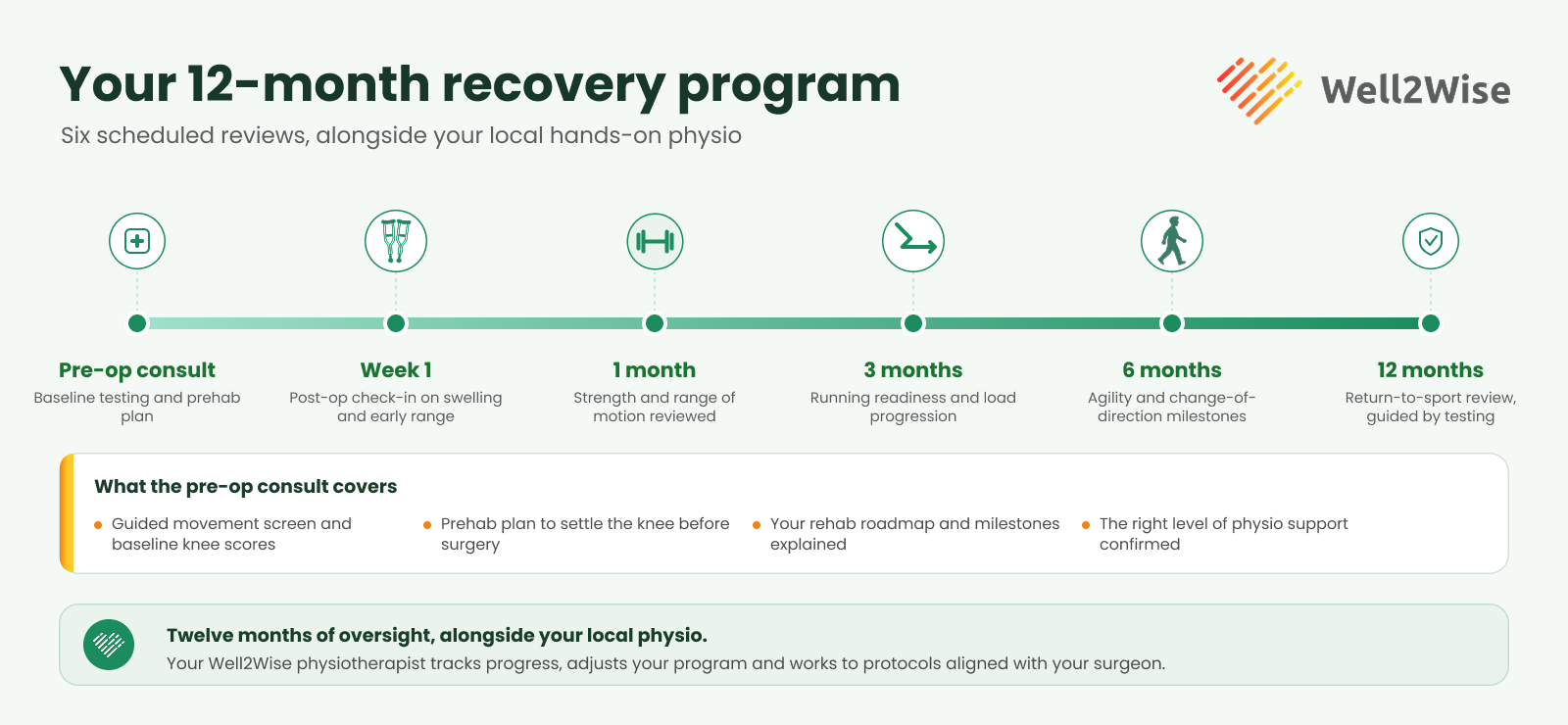
The milestones shown are indicative and reflect a typical ACL reconstruction recovery. Meniscal repair timelines differ, and a meniscectomy recovery is considerably shorter. Your own timeline is set by your surgeon and your treating physiotherapists.
Plus, throughout the 12 months
- Our exercise library. Pre-operative and post-operative exercise programs in the Well2Wise app, with video and written instructions for every movement. Your physiotherapist sets which stage you're working from, and it moves with you as your recovery progresses
- Education materials. Simple explanations of what each stage involves, what's normal, and what's coming next
- Your physiotherapist in the app, between consultations. For the quick questions and short chats that can't wait for a scheduled session, answered by your own physiotherapist and included for the whole 12 months
For the questions that can't wait for your next session
The scheduled consultations are where your recovery is properly reviewed, but recovery questions rarely time themselves to fit. The knee swells after a long day on your feet, something feels different in the gym on a Saturday, or you're just not sure whether an exercise is supposed to feel like that. Those don't need a full session, and they shouldn't have to wait for one. Send them to your physiotherapist in the app as they come up.
- Quick questions, straight to your physiotherapist. Anything from "should I still be limping at this point?" to "can I add load to this exercise yet?", answered by your own physiotherapist rather than a general help desk
- Show it, don't just describe it. Send a photo or a short video of the knee, or of you doing a movement. A ten-second clip of how the knee behaves in a squat usually tells your physiotherapist more than a paragraph can
- A video call when it's easier to look together. If something is better seen live, your physiotherapist can set up a short video call to look at it with you
- Always the same physiotherapist. You're talking to the person who has followed your recovery from the start and knows your operation, your goals and your history, so you're never re-explaining your knee from scratch
We aim to answer as quickly as we possibly can, and if a question turns out to need a proper look rather than a quick answer, your physiotherapist will bring it into your next scheduled consultation, suggest booking an additional one, or send you to your local physio or surgeon. Messaging isn't an emergency service, though: if you have severe pain, a hot or badly swollen knee, calf pain, shortness of breath, a fever, or anything else that worries you urgently, contact your surgeon's rooms or your GP straight away, or call 000 in an emergency. Don't wait on a message.
The exercise library, education materials and app messaging run for the whole 12 months; your clinical consultations are the six scheduled sessions listed above, and extra consultations can be booked separately whenever you want them.
Your physiotherapy in this program is provided by physiotherapists employed by Well2Wise. If you are having surgery, that surgery is performed by an independent orthopaedic surgeon at an independent hospital. Well2Wise handles the booking and payment side of it only.
This works alongside your local physio, not instead of it
Please read this part carefully, because it's the most important thing on the page.
The 12-Month Recovery Program is not a substitute for face-to-face physiotherapy. It does not replace hands-on treatment, and it does not replace your early post-operative rehabilitation, which needs someone in the room with you.
You should keep seeing a local physiotherapist for the in-person side of your recovery: hands-on treatment, supervised strength work, and the checks that need someone physically examining your knee.
Don't have a local physio yet? We'll help you find one
If you don't already have a physiotherapist, or you're not sure the one you have regularly works with post-operative knees, sorting that out is part of the program. Your Well2Wise physiotherapist will talk through what to look for in a local clinic and what your first few appointments there should cover.
We'll also connect you with a physio near you through our network of partner clinics, which is growing, particularly across Sydney. If you already have a clinic you like, or you need someone with particular experience, tell us and we'll arrange the referral. You're free to see any physiotherapist you choose; using our network isn't a condition of the program.
What this program adds on top of that:
- Oversight: a set of eyes on the whole 12 months, not just the block of appointments you're in right now
- Milestone review: scheduled points where your progress is reviewed against the stage you're at
- Progression guidance: help understanding what the next stage should look like and what to raise with your local physio and surgeon
- A consistent point of contact: someone who knows your history across the full recovery, including if you move, travel or change clinics
Two ways to see one of our physiotherapists
Different people need different amounts of support. Neither option is better than the other; they're built for different situations.
Rapid Telehealth Consult
Suited to a one-off question, a second opinion on how your progress is tracking, or a quick check between appointments with your local physio.
See how Rapid Telehealth Consults work →
12-Month Recovery Program
Suited to people who want structured oversight across the full recovery. That often includes people who are:
- returning to a pivoting sport such as football, netball, basketball or skiing
- fitting rehabilitation around work or study
- living regionally or remotely
- without easy access to a physiotherapist who regularly works with post-operative knees
Our physiotherapists
The consultations in this program are delivered by physiotherapists employed by Well2Wise.
- All are registered with the Australian Health Practitioner Regulation Agency (AHPRA), the national body that registers health practitioners in Australia
- All have substantial caseload experience in post-operative ACL and meniscus rehabilitation
- They work to rehabilitation protocols aligned with your operating surgeon, and communicate with your surgical team where that's appropriate and you've agreed to it
- Where practicable, the same physiotherapist follows you across the full 12 months, so you're not re-explaining your knee each time
Your physiotherapist works with your surgeon's instructions and your local physiotherapist's plan, not around them. If something in your recovery needs a face-to-face assessment or a surgical review, they'll tell you to go and get one.
If something doesn't look right
If your physiotherapist has a concern about how your knee is tracking, they'll raise it with you. Where your surgeon is part of the Well2Wise network, they can raise it with your surgeon's rooms directly, with your consent. Where your surgeon isn't part of the network, they'll tell you clearly what to raise and how soon, so you can take it to your own surgeon or GP. Either way, decisions about your surgical care are made by your surgeon.
Pricing
You see the price before you enrol, so you can plan for it. We're not trying to be the cheapest; we're trying to make the cost predictable.
- 12-Month Recovery Program: $650. An all-inclusive price covering the six scheduled telehealth consultations and your program materials across the 12 months
- Rapid Telehealth Consult: $40. A single 20-minute consultation
- Extended Telehealth Consult: $60. A single longer consultation
All prices include GST. Some health funds pay a rebate on eligible telehealth physiotherapy consultations.*
*Rebates vary between funds and levels of cover, and not all funds cover telehealth physiotherapy. Check with your insurer to confirm your eligibility before enrolling.
How it works
- 1. Enquire. Tell us your operation type and roughly when it's happening, or that you're still deciding, and we'll explain how the program would fit your recovery
- 2. You're matched with one of our physiotherapists. Based on your operation and your goals
- 3. Pre-op consult. Records your baseline, sets up your prehab plan, gets your local hands-on physio lined up and explains the roadmap ahead. If your operation has already happened, it becomes your baseline consultation instead
- 4. Scheduled reviews across 12 months. At 1 week, 1 month, 3 months, 6 months and 12 months, with your exercise library, education materials and app messaging available throughout
Common questions
Ready to talk about your recovery?
Send us your operation type and date and we'll explain how the 12-Month Recovery Program would work alongside your local physio.